
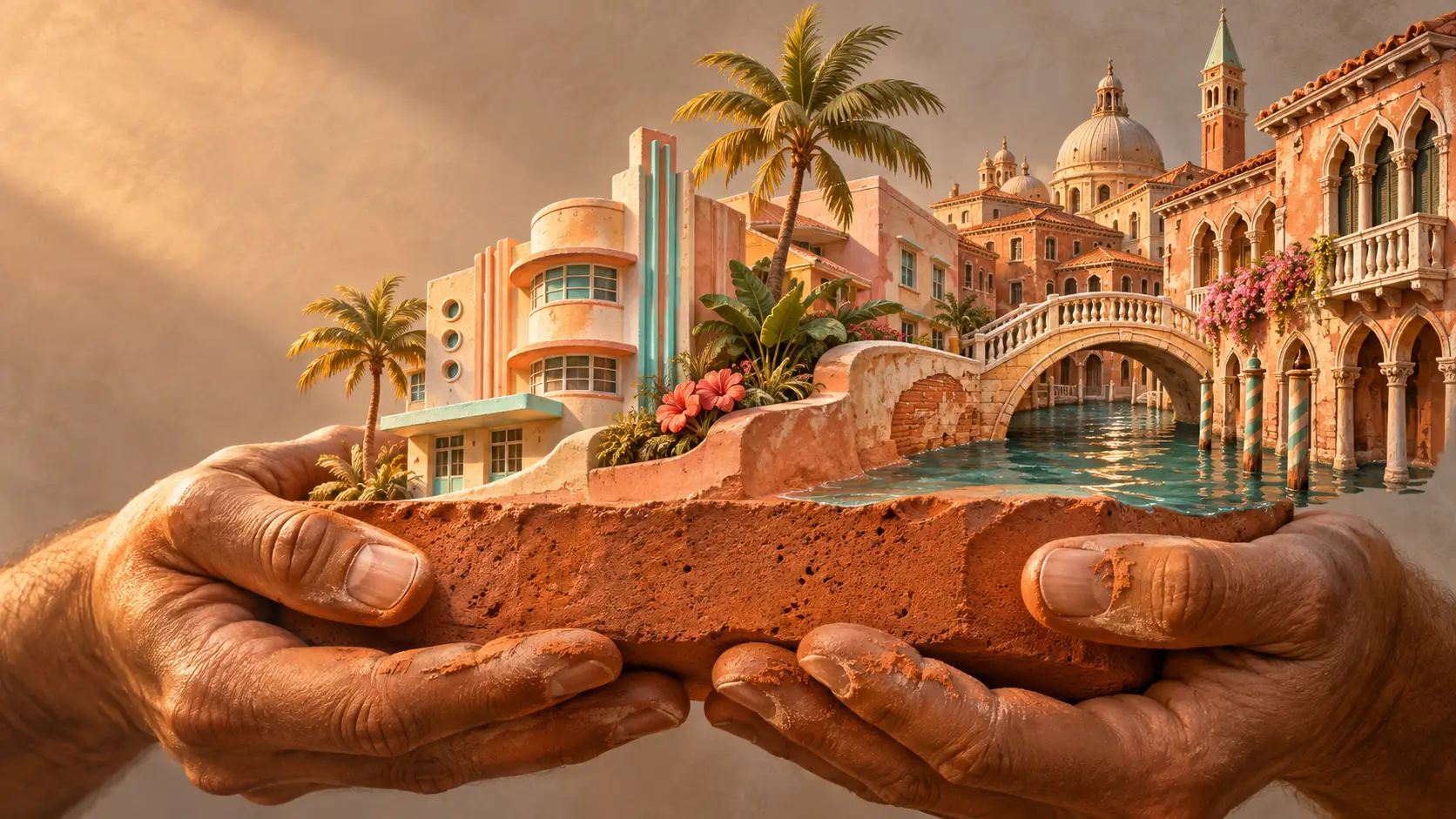

A University of Miami team’s U.S. Pavilion commission puts building materials and the people who work with them at the center of an international architecture exhibition.
A building usually reaches the public as a finished image. The façade is complete. The scaffolding has disappeared. The architect’s name accompanies the photograph.
Earth Craft, the planned U.S. Pavilion exhibition at the 2027 Venice Architecture Biennale, proposes looking earlier in that process: at the material being shaped, the knowledge required to work it, and the people whose labor becomes part of the finished structure.
The University of Miami School of Architecture has been selected to represent the United States. Architect and associate professor Germane Barnes will lead the exhibition, collaborating with Vyta Pivo, an assistant professor of architectural history and theory. The selection was announced November 6. Archinect.
For a publication concerned with the people shaping Miami, the commission offers two stories. One is the professional achievement itself. The other is the question the exhibition brings into view: how much of architecture can we understand if we overlook the people who build it?
Before the finished building
The exhibition will examine brick, rammed earth, adobe, and concrete masonry, tracing materials from the ground into buildings. Its stated focus includes the brickmakers, masons, and building communities whose expertise gives those materials architectural form. ArchDaily.
That approach changes where attention falls.
A material specification identifies what a designer intends to use. It does not, by itself, explain how a worker judges a mixture, handles an irregular unit, or adjusts a method when conditions change. Those decisions are part of making architecture, even when they remain absent from its public description.
The distinction matters to how we recognize professional achievement. A completed building can express an architect’s vision while also containing knowledge contributed by many other people. Giving that knowledge attention makes the account more complete.
Practice meets material history
Barnes and Pivo bring different forms of expertise to the project. Barnes leads Studio Barnes, a research and design practice concerned with architecture’s relationship to identity. Pivo’s scholarship examines construction labor, material lifecycles, and the histories of cement and concrete. ArchDaily’s account of the curatorial team.
The exhibition also intends to place inherited craft knowledge in conversation with computational design and robotic fabrication. The proposition is that emerging tools can learn from established ways of working. Wallpaper*.
For Miami, that creates a useful editorial question: when we describe innovation in architecture, do we look closely enough at the expertise already present in workshops and on construction sites?
Answering it requires reporting beyond the announcement. Architects, educators, fabricators, and tradespeople may describe innovation differently. Their accounts could reveal where knowledge moves between professions—and where it goes unrecognized.
A Miami connection that includes students
The planned participation extends into architectural education. According to The Architect’s Newspaper, University of Miami professor Maxwell Jarosz will work with students on an exterior courtyard installation incorporating earthen materials. The Architect’s Newspaper.
That provides a concrete connection between an international exhibition and work taking place within a Miami institution. It also creates an opportunity to follow the project as it develops: how students test materials, what they learn through fabrication, and how those experiences inform their design decisions.
Those outcomes remain to be documented. The commission has been announced; the finished exhibition has not yet been experienced by its audience.
What to watch next
The Biennale is scheduled for May 8–November 21, 2027. Earth Craft is expected to include a materials library, fabrication workshops, and a catalog. ArchDaily.
Its eventual significance will depend on how the exhibition makes its argument tangible. How will visitors encounter the knowledge of builders? How will contributors receive credit? What can an exhibition communicate about a skill that is learned through repeated physical work?
For MiamiFL.Today, those questions offer a way to cover achievement with curiosity: recognize the commission, follow the work, and widen the circle of people whose contributions become visible.
Choose one Miami building you pass regularly and learn who made it starting with the people and trades behind its materials.
Leave a Reply